
The Real Cost of Aging in Place vs. Moving to a Facility
What the monthly quote leaves out, and why home is often worth far more than it looks on paper.
For most people, a house that has held thirty or forty years of life is not really just a house. It is the kitchen where the family still gathers at the holidays. It is the neighbor who waves every morning, the church a few blocks away, the coffee shop that already knows the order, the bedroom where the morning light falls a certain way. It is a routine built over decades, inside a community of people who know you.
When a family starts weighing whether an aging parent should stay put or move into a facility, that is what is actually on the table. Not square footage and monthly fees. A whole life, and where it gets to keep happening.
So it is worth slowing down before anyone lists the house. Because when you compare the two paths honestly, with every cost counted, staying home is usually far less expensive than it first appears. And the things it protects, the ones that never show up on a spreadsheet, are often the ones that matter most.
It Usually Starts Small
Here is something families miss. The moment to think about aging in place is rarely a medical crisis. It is much quieter than that.
It is the morning the side of the bathtub starts to feel too high to step over. It is the hand that now reaches for the railing on the way down the stairs. It is standing up from a low toilet and noticing it takes a bit more than it used to. None of that means a person needs care. It means the house, built for a younger body, could use a few changes to fit the next chapter.
That is the hopeful part. Most aging-in-place work happens well before anyone needs help getting dressed or fed. It is not about decline. It is about staying ahead of it, so a small difficulty never turns into a fall, and a home someone loves keeps working for the person who loves it.
The Comparison Most Families Get Wrong
Most families put a monthly assisted living quote next to a remodel estimate, decide the remodel looks like a lot of money, and stop there. That comparison is missing almost everything.
It ignores what it costs to leave a home of thirty years. It assumes staying means hiring help, when often it does not. And it treats the monthly facility rate as a fixed number, when it is really a floor that rises every year.
Leaving Costs More Than Families Expect
Before a single month of rent is paid, moving out carries real costs.
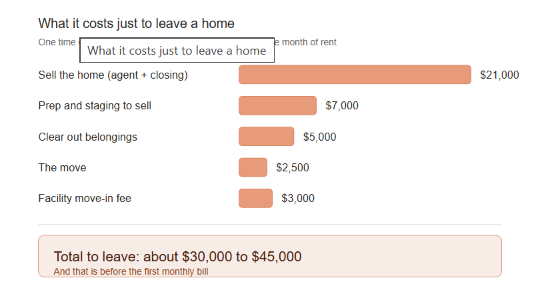
In New York, selling a home runs about 8 to 9 percent of the price once you add agent commissions and closing costs. On a $250,000 home that is roughly $21,000, before the repairs and staging most homes need to sell well. Then comes the hardest part: clearing out decades of belongings. A full cleanout runs about $1,500 to $6,000, estate sale companies take 25 to 40 percent of whatever sells, and a senior move manager to coordinate the sorting and setup runs about $1,500 to $8,000. Add the move itself and the facility's one-time move-in fee, commonly a few thousand dollars, and the total just to leave often lands somewhere between $30,000 and $45,000.
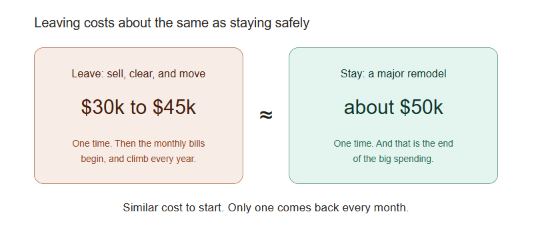
That number sits right alongside the cost of a comprehensive aging-in-place remodel, around $50,000. In other words, just leaving the house can cost nearly as much as making it safe to stay. Except leaving is where the monthly bills begin.
And no invoice captures the quieter cost: the weeks spent sorting a lifetime into keep, donate, and let go, and the ache of watching a family home come apart one box at a time.
And the Facility Bill Keeps Climbing
The advertised monthly rate is the floor, not the ceiling. Assisted living charges climb as needs grow, with add-ons for care levels, medication management, and more, so an advertised $5,000 a month commonly becomes $6,000 to $7,500 in practice. Rates also rise most years with labor costs and inflation.
And the path rarely stays put. The average assisted living stay is only two to three years, and many residents eventually move on to skilled nursing, where New York is among the most expensive states in the country at roughly $176,000 a year. What starts as one number tends to become an escalating series of them.
What it Costs to Stay
Making a home fit the next chapter is a one-time project, not a monthly bill, and it scales to the need.
A safety starter, with professionally installed grab bars, a comfort-height toilet, better lighting, and slip-resistant floors, runs about $1,500 to $3,000, and it prevents more falls per dollar than anything else, since most home falls happen in the bathroom. A curbless shower and a safe, step-free entrance, the core of most projects, run about $10,000 to $25,000. A comprehensive whole-home retrofit, with a full accessible bathroom, a stairlift or wider doorways, and first-floor living, runs about $25,000 to $75,000.
Whatever the scope, two things stay true. You keep paying only the ordinary costs of living somewhere, the taxes, utilities, and upkeep you would pay anywhere. And you keep the house itself, an asset that stays yours, can keep appreciating, and remains available to help fund care later if it is ever needed. Moving spends that asset down. Staying keeps it in the family.
Five Years, Side by Side
Put it on a five-year timeline for a healthy, independent person in a $250,000 Buffalo home, and the gap is hard to miss.
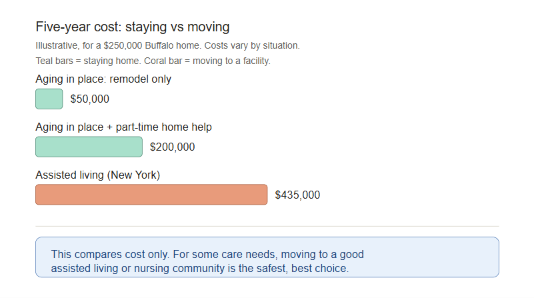
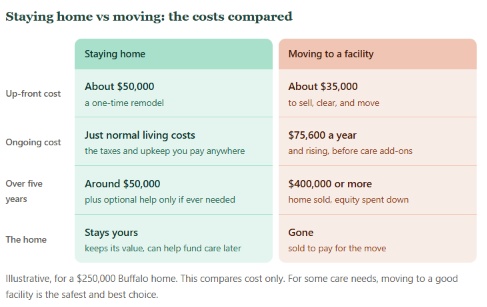
Staying home starts with a remodel of around $50,000, and from there costs little beyond the ordinary expenses of living anywhere. Moving starts with about $35,000 just to sell and relocate, then roughly $75,600 a year and rising, and commonly totals well over $400,000 across five years, with the home sold and its equity gone. Even if someone aging in place later chooses to add part-time help, the five-year total still tends to land near half the cost of a facility. Treat these as planning ranges, not quotes.
The Part No Spreadsheet Captures
Here is what the numbers cannot show.
For an older adult, home is not just shelter. It is the map their memory runs on: the path to the bathroom in the dark, the drawer where the spoons go, the face of the neighbor across the street. That familiarity is protective, and it matters more, not less, as memory softens. Geriatric clinicians even have a name for how hard a move can be on an older person, relocation stress. Pulled out of a known place and a settled routine, some people decline faster rather than slower.
Staying home keeps the things that keep people well.
The friends a few streets over. The grandchildren who can stop by after school. The church, the walking route, the Sunday habit. The plain dignity of making your own coffee, in your own kitchen, on your own schedule. These are not luxuries. For many older adults they are the difference between existing and living, and they are the first things a move quietly takes away.
When Moving is the Right Choice
None of this means a house is always the answer. Sometimes the most loving choice is a move, and the people who run good assisted living and nursing communities do hard, essential work.
When someone needs round-the-clock supervision, as with advanced dementia, or skilled medical care that a home cannot safely provide, or when a house simply cannot be adapted, or when isolation itself has become the real danger and a community would bring connection and relief, a facility can be exactly right. A move like that is not a failure. It is care, and it can be the most caring decision a family makes.
The point is only this: make that choice with the full picture in front of you, not a partial one.
How Families Pay
Staying is often more affordable than families assume. New York Medicaid waivers can cover items like ramps, grab bars, and bathroom modifications. Veterans with a service-connected disability may qualify for home adaptation grants. State and local programs help, and some modifications are tax-deductible when medically necessary. It is worth learning what applies before deciding the work is out of reach. We have a separate blog post about funding sources for accessibility projects on our site.
Bottom Line
A monthly facility quote gives you one number. It does not tell you what it costs to dismantle a home, or how that bill climbs year after year, or what is lost when a person leaves the community that has held them for decades.
Count all of it, and for most families whose home can be adapted, even a major remodel costs less over time. It also lets someone keep the life they built, in the place they built it. Sometimes a move is the right and caring choice, and when it is, it should be made with love and without guilt. But no family should choose it without first seeing everything that staying would have saved, in dollars, and in the things worth far more.
Ready to talk it through? Call or text HomeSafe Buffalo at (716) 238-2273 for a free
consultation.
Cost figures: national and New York care costs from the CareScout (Genworth) Cost of Care Survey (2025 national medians; most recent state-level release for New York figures). Home-selling, moving, estate-clearing, and modification costs from 2026 industry data. Regional and individual costs vary; use as planning ranges, not quotes.